Choosing your stretch of coast
Jambiani or Paje? Choosing Your Stretch of the East Coast
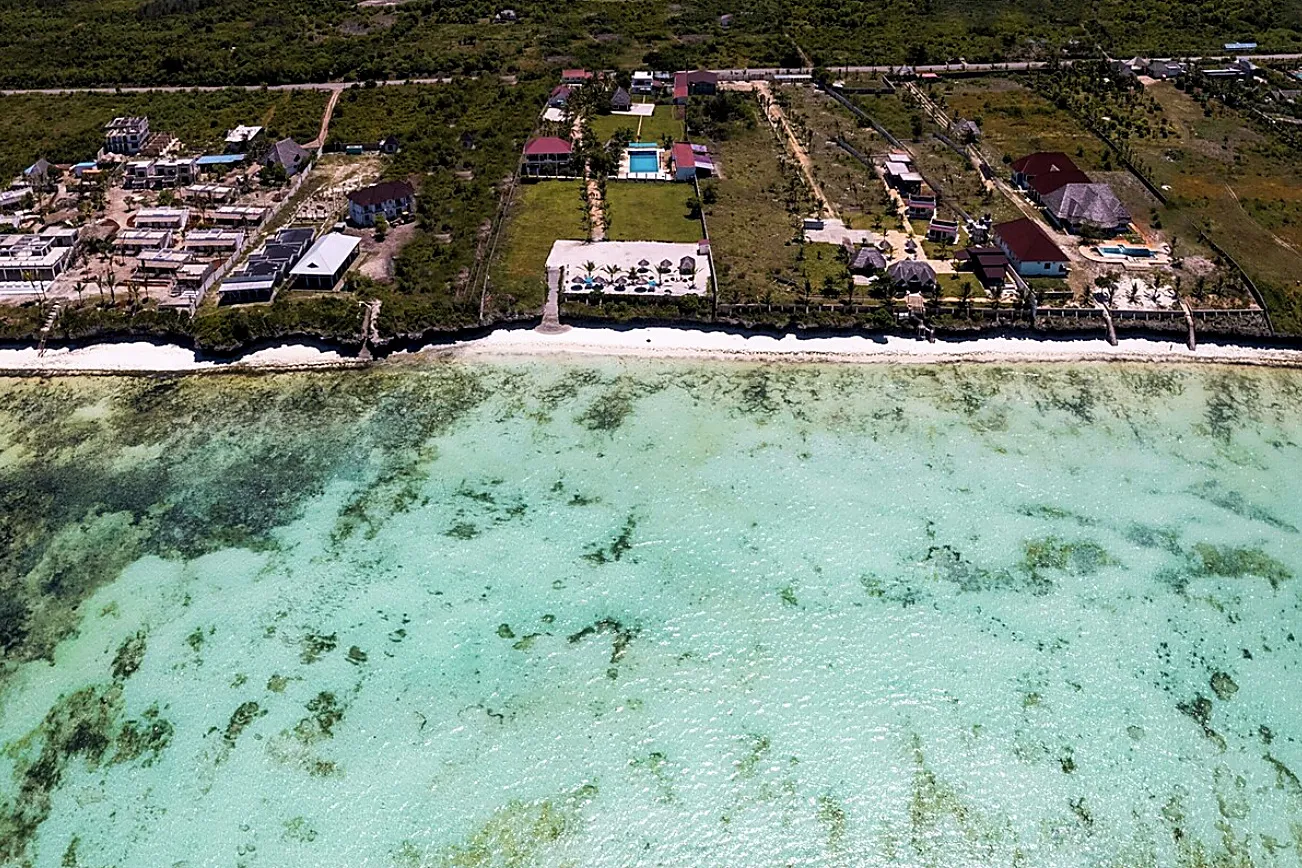
Paje and Jambiani sit four kilometres apart on the same lagoon, behind the same reef, with the same tide. On a map they look interchangeable. They are not.
Paje is the kitesurfing capital of the Indian Ocean. It is young, social and busy, with kite schools, beach bars and a scene that runs well into the evening.
Jambiani is a working village — fishing boats, seaweed farms, a few shops, and a beach wide enough that you can lose sight of other people on it.
If you kite, or you want somewhere with a pulse, choose Paje. If you want the coast itself, choose Jambiani. Almost everyone who ends up on this coast is happier having made that choice deliberately than having let a booking site make it for them.
The same water, two different beaches
Both villages sit behind the coral reef that runs down Zanzibar’s east coast, so the tide behaves identically in both. Twice a day the lagoon drains several hundred metres, and twice a day it fills back to chest-deep and pool-flat.
What differs is what happens on top of that water.
In Paje, the shallow flat lagoon and the steady kusi wind from June to September make near-perfect kiting conditions, and the village has organised itself entirely around that fact. On a good wind day the sky above the beach is full of kites and the water is full of students. It is genuinely impressive to watch, and if you are one of the kites it is one of the best places on earth to be.
In Jambiani, the same flat is a seaweed farm and a fishing ground. At low tide women walk out to the rows they have staked in the sand, and men push wooden boats across the shallows. It is a working shoreline, and it looks like one — which is precisely what one kind of traveller comes here for, and another kind does not.
Who each village is for
Choose Paje if
- You kite, or want to learn — the schools here are the best on the island
- You are travelling solo or with friends and want to meet people
- You want a beach bar within walking distance and something happening after dinner
- You are in your twenties, or would like to feel like it
- A busy beach reads to you as lively rather than crowded
Choose Jambiani if
- You want space — the kind where the nearest towel is fifty metres away
- You are travelling as a couple or as a family
- You would rather the village be a village than a strip built for visitors
- You would sooner walk out onto the flats at low tide than sit in a bar
- You want the same coast, the same water and the same reef for meaningfully less
- You are arriving off a safari and what you actually need is to stop
The four kilometres, honestly
It is worth being precise about the distance, because four kilometres sounds like nothing and behaves like a lot.
- PajeKite schools, beach bars, and a scene after dinner
- JambianiA working village, and where Raffia is
You can walk between the two villages along the beach at low tide. It takes roughly an hour, and it is one of the better walks on the island — firm sand, tidal pools, the reef breaking out on the horizon the whole way. Plenty of guests staying in Jambiani go up to Paje for an afternoon, eat somewhere with a crowd, and walk back. The reverse happens far less often, which tells you something worth knowing.
By road it is a few minutes. Neither village is stranded, and both are the same distance from Stone Town and the airport.
So the choice is not about access. It is about which one you want to wake up in.
What you give up in Jambiani
We are not going to pretend the choice is free.
Restaurants. Paje has more of them, and more variety. In Jambiani you eat at your hotel or at one of a handful of village places, and on a Tuesday in low season some of those will be closed.
Nightlife. There isn’t any. The loudest thing after ten o’clock is the sea.
Activity infrastructure. If you want to book a different watersport every morning, Paje makes that easier.
For some people those are dealbreakers, and they should book Paje with our blessing. For others, that list reads less like a set of drawbacks and more like a description of the holiday they were hoping for.
What you get instead
Space, mostly — but it is worth being concrete about what that means here.
At low tide the beach in front of Jambiani is several hundred metres deep and kilometres long, and there are not enough people on this coast to fill it. You can walk for an hour in either direction. The tidal pools are bath-warm. The reef breaks in a white line on the horizon and you can hear it from the sand.
At high tide the lagoon comes back flat and warm and you swim straight off the beach, usually with almost nobody else in the water.
That space is why Jambiani suits couples and families better than it suits anyone looking for a scene.
And in between, the village goes on doing what it did long before any of us arrived: boats out in the morning, seaweed at low water, children on the sand in the late afternoon. You are a guest in a place that exists for its own reasons.
That is a specific pleasure, and it is not available in Nungwi at any price.
Where we sit
Raffia is in Jambiani, directly on that beach, with twelve rooms.
We chose this village over Paje deliberately, and for the reasons above. It is quieter, it is more itself, and the coast in front of it is the part of Zanzibar we would pick if we were the ones on holiday.
If you have read this far and the Paje list was the one that sounded like you — go, honestly, and have a good time. The kiting really is world-class, and you would be wasting it here.
But if it was the second list, and the words that stuck were space and quiet and somewhere that still feels like itself: you have chosen your stretch of coast. We are on it.