Choosing the kind of place
Twelve Rooms or Two Hundred: How Hotel Size Changes a Zanzibar Holiday
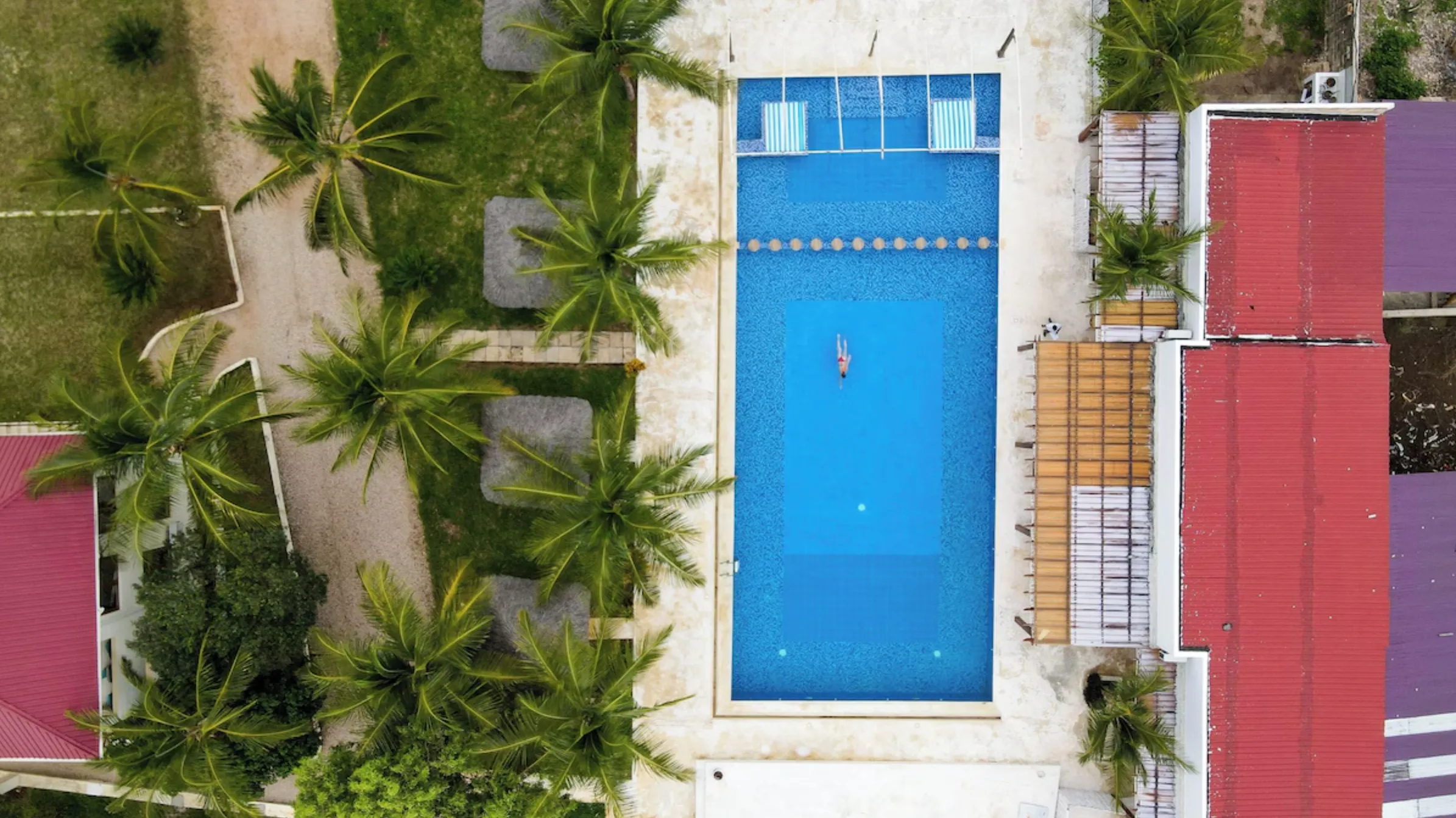
Most people choose a Zanzibar hotel by looking at photographs and price. Almost nobody chooses by room count, and yet room count changes the holiday more than almost anything else on the page.
Space
A small hotel gives you room on the beach, food cooked to order, and staff who know your name by the second morning.
Choice
A large resort gives you a choice of restaurants, activities on site, somewhere to go when it rains, and a well-drilled machine behind it.
You are not choosing between good and bad. You are choosing between these two, and you cannot have both. Everything below is that one trade, priced out.
The number that actually matters
Not rooms. Guests per metre of beach.
A hotel’s room count on its own tells you very little, because a two-hundred-room resort usually sits on a much longer stretch of sand than a twelve-room property. What matters is the ratio between the two.
Work it roughly: multiply rooms by two for guests, then divide by the metres of beach frontage. On Zanzibar the results tend to fall into three bands. A small hotel of eight to twenty rooms puts roughly three guests on every ten metres of sand; a mid-size property of forty to eighty rooms puts roughly six, and a large resort of a hundred and fifty rooms or more puts ten or more.
| Category | Typical guests | Typical frontage | Guests per 10 m of beach |
|---|---|---|---|
| Small hotel8–20 rooms | 20–40 | 60–100 m | roughly 3 |
| Mid-size40–80 rooms | 80–160 | 150–250 m | roughly 6 |
| Large resort150+ rooms | 300+ | 250–400 m | 10 or more |
It is also the easiest thing to check before booking. Ask the hotel two questions: how many rooms, and how many metres of beach. A property that answers both without hesitating is usually a property worth staying at.
What changes as the numbers go up
Breakfast. At twelve rooms, breakfast is a table and someone asking how you slept. At two hundred, it is a buffet with a queue at the egg station between eight and nine. The food can be excellent in both cases; the experience is not comparable.
Dinner. This is the sharpest line of all. A small kitchen cooks a short menu to order, often around whatever the boats brought in that afternoon. A large kitchen builds a buffet that has to satisfy hundreds of people with different tastes, which means it is designed to be inoffensive rather than memorable. Some large resorts run à la carte restaurants alongside the buffet, and those are usually the better option if you have one.
Being recognised. At a small property this happens on day two whether the staff try or not. At a large one it cannot happen, no matter how well trained the team is — there are simply too many faces.
The beach. See the table above. This is the difference people describe afterwards when they say a place felt “busy” or “empty” without being able to say why.
Noise at night. Large properties usually have entertainment, a bar with a sound system, and more people awake late. Small ones usually have neither, and on this coast the loudest thing after ten is the sea.
Check-in and check-out. Twelve rooms means someone walks you to your room. Two hundred means a desk, a queue at eleven in the morning, and a wristband.
What you give up at a small hotel
We should be straight about this, because the small-hotel case is usually made by small hotels.
Choice of restaurants. One kitchen, one menu, every night of your stay. Most small hotels vary it, and after ten nights you will still have eaten the same style of cooking ten times. If you like choosing where to eat, this will grate — and it is worth reading alongside the board basis, which is the other half of the same decision.
Facilities. No gym worth the name. Usually no dive centre on site. A pool you can cool off in rather than swim lengths in. Massage rather than a spa menu.
Somewhere to go when it rains. This is underrated. A large resort has covered spaces, a bar, activities, and enough people that a wet afternoon is bearable. At a small property on a rainy day there is your room, the restaurant, and a book.
Anonymity. Being known by name is lovely right up until it is not. If you want to disappear for a week and speak to nobody, a large hotel does that better.
A back-up if you dislike the place. At two hundred rooms you can find a corner that suits you. At twelve, if the atmosphere is not for you, there is nowhere else to be.
What small hotels are not
They are not automatically cheaper. Small properties spread fixed costs — staff, generator, water, kitchen — across far fewer rooms. On Zanzibar, mid-range small hotels on the east coast often sit below large resorts on the north-west, but that is mostly a coast difference rather than a size difference. Small and luxurious is frequently the most expensive category on the island.
They are not automatically better run. A twelve-room hotel with weak management has nowhere to hide. A large resort has systems that carry it through a bad week. Read recent reviews for small properties specifically — the variance is much wider than at the big chains.
They are not automatically quieter. A small hotel next to a beach bar is louder than a large resort on an empty stretch. Location beats size on noise, every time.
Which to choose
-
Choose a large resort if
you want a choice of restaurants, activities on site, a proper spa and gym, something to do on a wet day, all-inclusive convenience, or you are travelling with children who would enjoy a kids’ club.
-
Choose the middle if
you want a bit of both and are willing to have neither in full. Forty to eighty rooms. A great many good Zanzibar hotels sit here, and for most travellers it is a sensible answer.
-
Choose a small hotel if
you want space on the beach, food cooked rather than assembled, a slower pace, staff who know you, and a place that feels like somewhere specific rather than somewhere interchangeable.
Where we sit
Raffia is twelve rooms, on a private stretch of beach in Jambiani. Everything in the small-hotel column above applies to us, including the parts that are not flattering: one kitchen, no gym, no spa menu, and nothing much to do if it rains all day.
What we have instead is the ratio at the top of the table. Twenty-four guests at full occupancy, on a beach where at low tide you can walk for an hour in either direction. Staff who will know how you take your coffee by Tuesday. And a kitchen small enough to cook what came off the boats that afternoon.
If the list of things you give up read as a set of drawbacks, book somewhere larger and have a good holiday. If it read like a description of the trip you were hoping for, you already know which column you are in.
If you have not yet chosen a coast, start with Where to Stay in Zanzibar. Travelling as a couple? What Makes a Zanzibar Hotel Romantic. Working out the board basis? All-Inclusive, Half Board, or Bed and Breakfast.